About Laure

This author has not yet filled in any details.
So far Laure has created 4 blog entries.

Head office-field coordination: a sustainable performance lever for companies

In multi-site organizations, performance is not decided solely at head office. It's built up in the field, where teams operate, carry out their tasks, deal with unforeseen circumstances and represent the company to customers.

But here's the thing: the more the business grows, the more complex coordination becomes.

So how do you ensure structured management of field teams without rigidifying the organization ?

How do you supervise mobile staff while maintaining commitment and efficiency?

And above all, how to transform this coordination into a genuine driver of sustainable performance ?

The answer lies in a subtle balance: clear management, fluid processes and a functional tool capable of supporting the business without weighing it down.

Why has field team management become a strategic issue?

Field teams are now at the heart of value creation. In many sectors, such as cleaning, personal services and private security, the quality of the work carried out on site has a direct impact on the success of your business. customer satisfaction and the sustainability of contracts.

Employees in the field guarantee :

  • business continuity, even in unforeseen circumstances
  • compliance with contractual commitments
  • quality perceived by the end customer
  • corporate image and credibility

Unlike sedentary personnel, mobile teams operate in an unstable environment. They have to cope with geographical dispersion, emergency management, time pressure and sometimes a high degree of autonomy in carrying out their tasks.

In this context, the management of field teams cannot be limited to simple administrative follow-up. It becomes a strategic challenge. Without clear visibility of actual activity, head office has difficulty anticipating needs, adjusting resources or measuring operational performance.

But how can you effectively control what you can't see? A smooth coordination between management and the field transforms this complexity into a competitive advantage. It gives the company a capacity for anticipation, adaptation and optimization that makes all the difference in demanding markets.

Disengagement, disorganization, loss of performance: the risks of poor coordination

When coordination is based solely on informal exchanges, e-mails or isolated spreadsheets, malfunctions appear quickly. Information flows poorly, responsibilities are blurred and management becomes reactive rather than proactive.

Operational consequences

On an operational level, the effects are tangible, with the risk of poorly executed or duplicated tasks due to a lack of shared visibility. Companies can also experience delays due to poorly transmitted information or badly updated schedules. Not to mention the time wasted correcting errors rather than managing the business.

Human consequences

The impact is not just technical: it's also human. 

A field team lacking clear instructions or feedback on its work can gradually lose motivation. Lack of coordination creates a feeling of isolation. Employees have the impression of being subjected to head office decisions rather than contributing to them. 

In the medium term, this means :

  • a loss of meaning and commitment
  • an increase in turnover
  • a deterioration in service quality
Economic consequences

Business repercussions quickly follow. 

A poorly structured organization leads to lower productivity and higher costs. invisible additional costs These include unanticipated overtime, corrective action, contractual penalties or customer tensions. Don't forget that a deteriorating customer relations can precipitate the end of a contract, and damage the structure's reputation. 

So poor coordination is not just an organizational problem. It directly affects the overall company performance.

The levers of effective, sustainable field management

Implementing effective management of field teams requires action on organization, managerial culture and tools.

A clear framework for mobile teams

The first lever is to make the framework explicit. The roles, responsibilities and field procedures must be formalized. Clear management reduces grey areas and makes task execution more secure. Every employee needs to know what is expected of him or her, and by what deadlines and quality standards.

A clear, usable view of the terrain

The second lever is based on quality of information feedback. Without reliable data and established processes to pass it on to management, performance is difficult to assess, analyze and improve. Management becomes uncertain, and decisions are based more on intuition than on measurable facts. 

Head office therefore needs to have a reliable, up-to-date view of the terrain in order to adjust its choices. 

This implies structured follow-up : 

  • working hours
  • of interventions carried out
  • and any incidents
Autonomous and supervised teams

Effective management does not mean constant control. On the contrary, it's about giving field teams a sense of supervised autonomy. An autonomous but isolated team can drift. An autonomous, well-equipped team performs better.

A mastery of social and regulatory obligations

Finally, the respect for the legal framework is an essential pillar. Management must integrate obligations linked to labor law, traceability and HR compliance. Rigorous organization protects the company, while ensuring the safety of its employees! 

In short, sustainable field management is based on four balances:

  1. Structure without rigidity.
  2. Empowering without losing control.
  3. Measuring performance without complicating management.
  4. Integrate respect for the legal framework as the basis for coordination.

Centralizing without rigidifying: the key role of digital tools in headquarters-field coordination

On a small scale, an organization can operate with dispersed tools. But as soon as the number of sites, interventions or teams increases, limits appear. Do you know why? 

Because fragmented systems lead to :

  • increased re-keying and risk of errors
  • a lack of instant insight into the field
  • difficulty optimizing schedules and resources
  • constant juggling between Excel, e-mails and calls
  • a growing administrative burden for the head office

Hence the importance of complete business software, dedicated to managing field teams. Far from being an additional constraint, it is, on the contrary, a lever for efficiency.

A high-performance tool makes it possible to centralize data, of reliable information and’improve coordination. The head office has a real-time vision and consolidated indicators for activity management. Teams in the field can easily access their missions, report adjustments and track their priorities.

The benefits are twofold: time savings for support functions and simplification of day-to-day operations!

Keep in mind that digitalization doesn't replace management, it reinforces it. It converts data into decision-making support, optimizing the organization without weighing down processes.

How do Groupe Senef's solutions transform head office/field coordination into a performance driver?

Groupe Senef's solutions are in line with this approach: helping companies to structured, efficient and sustainable management of field teams.

By concentrating task, schedule, time and activity information in a single software package, the organization benefits from a coherent, global vision. This centralization optimizes day-to-day management and reduces the risk of errors.

The links between support functions, managers and field teams are more fluid. Decisions are based on reliable, up-to-date, usable data. Managers can analyze performance gaps, identify areas for improvement and adjust resources according to real needs.

In practical terms, this means :

  • better anticipation of workloads and priorities
  • a reduction of administrative tasks with low added value
  • precise monitoring of work carried out
  • a continuous improvement in operating performance

Employees in the field gain greater autonomy and visibility. Head office regains its capacity for strategic anticipation. Coordination ceases to be an operational hindrance, and evolves into a strategic priority. a powerful engine of transformation.

In short, better coordination for better performance!

In an environment marked by geographically dispersed teams, organizational complexity and increasingly demanding customers, coordination is becoming a decisive factor. Today, it is a a key challenge for multi-site, operationally-intensive companies

This link between the field and head office is a key factor in the success of our business. formidable engine : 

  • efficiency, as it allows you to optimize resources and manage time more effectively 
  • commitment, because it gives teams visibility and meaning
  • quality, because it secures execution and enhances customer satisfaction

Companies that choose to invest in a structured management approach, supported by tools adapted to the realities of the field like Groupe Senef's solutions, give themselves a sustainable competitive edge.

The question is no longer whether coordination should be improved. It's a question of determining how to make it a fully-fledged strategic lever, in the service of controlled, sustainable performance.

To contact us, click here: Marketing@groupesenef.com
Follow us on LinkedIn 

By |2026-03-30T19:41:59+02:00March 6th, 2026|planning|0 Comments

Interclean: the leading international trade fair for professional cleaning and sanitation

As you know: the professional cleaning sector is constantly evolving. Between increased hygiene requirements, organizational changes, pressure on margins and ever higher customer expectations, companies must constantly adapt their practices.

In this context, certain events play a key role in supporting the development of players in the field.

Interclean is one of those not-to-be-missed events.

Held in Amsterdam, this international benchmark show brings together the entire professional cleaning ecosystem to showcase the latest innovations, solutions and equipment on the market.

But what makes Interclean so special?

Why does it attract thousands of visitors and exhibitors from all over the world every year?

And how it can really support the performance and evolution of a cleaning business ? Zoom in on a biennial highlight not to be missed.

Interclean: definition and role of the show in the professional cleaning ecosystem

Interclean Amsterdam is now recognized as a the world's largest and most influential trade show for cleaning, hygiene and professional cleaning services on an international scale.

A veritable crossroads of exchange and innovation, this major event brings together all industry players under one roof. The aim? Present the latest market advances, share best practices and anticipate future developments.

With over 900 exhibitors from all over the world and around 30,000 visitors representing over 140 countries, Interclean has become the undisputed global benchmark for the cleaning industry. 

Beyond its commercial dimension, the show plays a key role in the professionalization of the sector. It highlights cross-functional issues such as operational performance, digitalization of organizations, improved working conditions and sustainable development. In this way, Interclean is actively helping to shape the future of the cleaning industry.

When does Interclean take place and how often?

The very first Interclean Amsterdam was held in 1967! Since then, the show has been held every two years, traditionally in the spring. This biennial rhythm enables exhibitors to present truly structuring innovations, while providing visitors with a clear vision of major market trends.

The next edition of this flagship event is scheduled from April 14 to 17, 2026, and as every year, it will take place in the Dutch capital. The choice of’Amsterdam as host city is no mean feat. The metropolis offers exceptional accessibility thanks to its central position in Europe, its international Schiphol airport and its efficient transport network.

The RAI Amsterdam Convention Centre, The exhibition center, where the event takes place, boasts a modern infrastructure spread over 12 exhibition halls. Enough to comfortably accommodate the thousands of visitors and exhibitors expected!

What type of salon is Interclean?

Interclean is above all a B2B (Business to Business), designed to meet the specific needs of cleaning professionals.

Visit profiles present are varied:

  • directors and managers of cleaning companies; 
  • buyers and specifiers of cleaning services ;
  • manufacturers and distributors of equipment and products ;
  • building and facility management players;
  • hygiene and sanitation experts;
  • researchers and innovators in the sector. 

The event covers all aspects of professional cleaning : 

  • detergents and disinfectants ; 
  • material, equipment, machinery ;
  • health and hygiene ; 
  • steam and high-pressure cleaning ; 
  • sanitary ; 
  • window cleaning ; 
  • linen and textile care ;
  • data and technology. 

In terms of organization, Interclean has dedicated zones for each of these segments to facilitate targeted exchanges and the discovery of relevant offers according to activities. 

This global approach is ideal for giving visitors a complete picture of the market and enabling them to identify solutions tailored to their specific challenges!

What you'll find at Interclean: innovations, solutions and industry trends

Interclean is first and foremost a a formidable showcase for the latest trends in professional cleaning. The show highlights concrete innovations designed to improve performance, service quality and working conditions.

Among the major trends observed appear :

  • robotization and automation of cleaning tasks;
  • connected solutions and the use of data;
  • intelligent resource management systems ; 
  • ergonomic equipment to enhance team safety and comfort;
  • environmentally-friendly products and approaches;
  • advances in sanitary hygiene and disinfection;
  • new approaches to building maintenance and management.

The show also offers a rich program of more than 100 conferences, demonstrations and interactive workshops. These highlights enable visitors to deepen their knowledge, take a step back, analyze changes in the sector and feed their strategic thinking.

Visit Amsterdam Innovation Awards are awarded to the most promising solutions on the market.

Taking part in Interclean means benefiting from a concentration of international expertise in a single location, with an eye to the future.

How can we fail to see this as a lever for accelerating our development?

Why visit Interclean if you run or are developing a cleaning business?

The question to ask is this: In a competitive and ever-changing environment, is it really possible to miss out on such an event? It's no secret that Interclean represents a strategic opportunity not to be missed by cleaning company directors and managers.

Visiting the show is all about access a complete watch on the latest offers, equipment and solutions available worldwide. It's also an opportunity to compare, question and anticipate market trends. Interclean Amsterdam is a veritable laboratory of ideas. It's teeming with innovations that can considerably improve the daily lives of cleaning companies and their teams! 

Interclean also encourages business development and professional networking. Meetings with other visitors, exhibitors and potential partners enable us to forge lasting relationships, identify new opportunities and better understand customer expectations. 

Finally, the show offers a strategic breathing time. By taking a step back from your business, drawing inspiration from observed practices and exchanging ideas with experts, it becomes easier to structure a clear, long-term vision for your company.

A single visit for multiple, substantial benefits!

Progiclean, a Groupe Senef brand, at Interclean: supporting the performance of cleaning companies

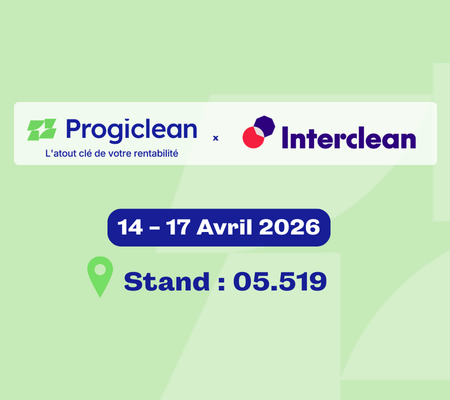
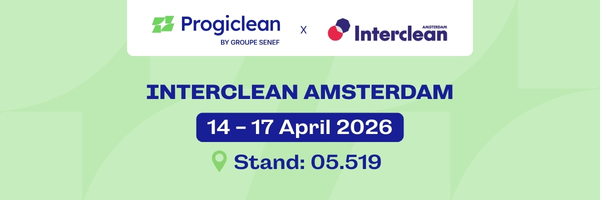
At the next edition of Interclean Amsterdam, Progiclean will be present on stand 05.519. The aim is not to make more promises, but to provide concrete answers to the issues observed in the field and during previous editions.

Developed by Groupe Senef, Progiclean is a solution designed to structure, manage and develop a cleaning and multiservice business. This 100 % web software centralizes all key processes: sales management, scheduling, service monitoring, invoicing, human resources and customer relations.

Our approach is fully in line with the dynamic promoted by Interclean. Organization, performance, service reliability and optimized working conditions are all subjects at the heart of the concerns of visitors to the show.

Progiclean responds to these challenges by offering a structuring system, a company capable of supporting the growth and transformation of cleaning companies. Its native integration with Silae simplifies payroll management, a strategic point in a sector heavily dependent on human resources.

Technological innovations aside, one thing is clear: a tool without in-depth knowledge of business issues is not enough. These are expertise, in-depth understanding of field practices and long-term support that turn a solution into a real performance driver.

Visit us on stand 05.519 at Interclean Amsterdam, from April 14 to 17, to find out how Progiclean is responding to the changing needs of the cleaning sector!

To contact us, click here: Marketing@groupesenef.com
Follow us on LinkedIn 

By |March 30, 2026, 7:42:54 PM UTC+2March 6th, 2026|Event|0 Comments

Centralizing your company's management tools: an essential performance lever

Introduction

How many different tools do your teams use on a daily basis to manage schedules, track interventions, process HR data or produce reliable reporting? 

For many service companies, the answer is often disconcerting: several software programs that don't communicate, information scattered in separate files, employees juggling separate workspaces...
Centralize your company's management tools is no longer an option: it's an operational imperative, and a concrete performance lever.


Why dispersed tools are a drag on business performance

Software multiplication and loss of consistency

In field-intensive organizations, the proliferation of software is an often underestimated reality. One tool for scheduling, another for payroll, a third for tracking interventions, a fourth for invoicing... The result: a lot of time and effort. fragmented data, We have to deal with systems that don't talk to each other, and employees who are forced to carry out time-consuming re-entry tasks. Every double entry is a potential source of error. Every error is a hidden cost. And every hour spent reconciling contradictory information is an hour subtracted from the real value of the work.

This compartmentalization of management tools is not only detrimental to individual productivity: it also undermines the overall coherence of the organization. When teams work with heterogeneous tools, operational visibility deteriorates and decisions are taken too late, or on the basis of incomplete data. Processes fall out of sync, inter-departmental communication becomes more complex, and the ability to act quickly is eroded.

Lack of overall business visibility

A technologically dispersed organization is also a strategically blind organization. Without centralized system, For a company with dozens of employees on several sites, producing complete, reliable reporting is a laborious exercise, often carried out too late to be of any real use. For the manager of a company with dozens of employees on several sites, the absence of a complete and reliable reporting system can be a real problem. consolidated vision in real time represents a major operational handicap. It becomes impossible to quickly identify a deviation, anticipate a malfunction or measure the real impact of a decision taken the week before. Steering is done blindly, on the basis of feedback from the field, which is always too partial to be reliable.

Operational and legal risks

The dispersal of information is not just a question of efficiency: it also generates serious operational and legal risks. Administrative errors multiply when data circulates manually between unconnected systems. Regulatory compliance is difficult to guarantee without centralized traceability. And the data confidentiality, Information security, whether for customer information or employee personal data, can only be effectively ensured if the entire information system is controlled from a single point of control. Dispersed access means a risk of leakage or non-compliance that is difficult to control.

Centralizing your tools: definition and key principles

What is the centralization of management tools?

Centralize management tools, The key is to bring data, processes and teams together in a single, coherent system. In concrete terms, this means that all business-related information can be accessed from a single platform, shared by all employees concerned, with appropriate access rights for each profile. This logic is generally embodied in a ERP (Enterprise Resource Planning) or in a business software specialized, designed for the specific needs of an industry.

The aim is to ensure that information flows freely, that tools speak the same language, and that the field and head office share a common vision. Only then can coordination cease to be a constraint and become a real driver of operational performance.

Which processes can be centralized?

In a service company, centralizable processes are numerous and interdependent: 

  • Visit HR management (contracts, authorizations, absences, training) can be integrated with planning data to avoid assignment conflicts.
  • The schedule updated in real time, becomes accessible to agents and operations managers alike.
  • Visit billing is automatically generated from operational data, with no need for re-entry.
  • The customer care, This allows us to maintain a consistent level of service.
  • Visit document management is secure and traceable. 

And the reporting, finally, reflects the actual state of the business, without delay or approximation.

Centralization vs. tool stacking

It's important to distinguish true centralization from the illusion of it: the stacking of applications.
Adopting a new tool for each identified problem only adds to the complexity, while giving the impression of modernizing the organization. The logic of system is fundamentally different from the tool logic: where the tool meets a specific need, the system structures the whole activity in a coherent and lasting way. 

Technology doesn't create performance: it enables it by aligning, connecting and driving teams, data and operations in a coherent way. It is this distinction that determines whether digital transformation actually creates value, or merely shifts complexity.

The concrete benefits of centralization for the company

Time savings and productivity

The first visible benefit of a centralized management system is to save operational time. Fewer re-entries, fewer errors, more control over day-to-day operations: automating repetitive tasks frees up teams for higher value-added missions. Visit productivity progress not because we work more, but because we work better, with the right tools, at the right time, from the right place. The simplification of administrative processes translates into smoother working days, less frustration, and energy better focused on the essentials.

Improved team collaboration

Centralization also transforms the way teams work together. When all information is accessible in a single unified workspace, silos disappear. An operations manager can see the status of current missions in real time. An HR manager has access to the same data as the operations department. Better-coordinated teams and frictionless information flows: that's the key to success. collaboration really effective. For multi-site structures, this is a structuring advantage, as it enables all activity to be managed from a central point, without losing sight of what's happening in the field.

Strategic steering based on reliable data

A real-time reporting, With consolidated, reliable indicators, the quality of strategic decisions is profoundly changed. Rather than working with data aggregated at the end of the month, which is often incomplete or already obsolete, managers have an up-to-date view of their business, at any time. Reliable, centralized data that can be exploited in real time makes it possible to identify a performance gap, adjust a resource, or arbitrate between two priorities, with the certainty that the information accurately reflects the reality on the ground. Decisions become faster and more relevant.

Improving customer satisfaction

The quality of customer service is directly linked to the reliability of internal information. When data is centralized, invoicing errors are rare, unforeseen events are dealt with more quickly, and the information transmitted to the customer is consistent, whoever the contact. This greater responsiveness and consistency in customer relations generate lasting trust, which translates into better customer service. satisfaction and loyalty. A well-served customer is a customer who stays.

Centralize to improve the quality of strategic decisions

Data as the basis for global management

Beyond the immediate operational gains, centralization creates the conditions for truly strategic management. Having a unique database This consolidated approach enables us to adopt a multi-site, multi-team, multi-activity vision. Groupe Senef deploys its business ERP model in very different environments, but faces the same fundamental challenges: human coordination, operational visibility and performance on the ground. A group operating on several sites can finally compare performance between them, identify the most effective practices, and generalize the approaches that work. This level of analysis is only possible if data is homogeneous, structured in the same way, and available from the same system.

Reducing uncertainty in decision-making

Decision-making in an uncertain environment is one of the most constant challenges for managers of service companies. The data centralization does not eliminate uncertainty, but it does considerably reduce it. By making it possible to’identify The ability to quickly identify discrepancies between set objectives and actual results provides a level of anticipation that fragmented organizations simply don't have. A problem detected early costs infinitely less to correct than one discovered after it has had its full effect. And in such a demanding sector, anticipating operational risks is not a luxury: it's a necessity.

Transforming the organization into a data-driven system

The real promise of centralization is to move from reactive to proactive management. By exploiting activity histories, measuring the real impact of decisions taken, and cross-referencing data that were previously siloed, the organization is gradually transformed into a "one-stop shop". data-driven system.

Decisions are no longer based on intuition or approximation, but on verifiable, up-to-date and exploitable facts. A unified vision of the business, from field to head office, enables decision-makers to draw on reliable information to build a coherent strategy. It's a far-reaching transformation that reinforces a company's competitiveness and adaptability over the long term.

How to successfully centralize your management tools

Identify specific company needs

Before choosing a management solution, It's essential to understand your organization's real needs. 

The size of the company, its organizational structure, legal constraints and short- and medium-term performance objectives are all parameters which must guide the choice. A structure with 50 agents has different needs to a group of 500 employees spread over several regions. 

The first step is to understand the uses, constraints, realities on the ground and human interactions that make an organization function on a day-to-day basis. A rigorous internal audit, conducted with operational teams and functional managers, is often the first essential step in a successful centralization project.

Choosing the right solution (ERP or business software)

The choice between ERP generalist and a business software is a structuring decision.

A general-purpose ERP may cover many processes, but it doesn't necessarily understand the specifics of a particular business sector. 

Business software, designed for a specific context, natively integrates the functionalities and constraints specific to the sector, resulting in faster adoption and a better match with actual usage. The key criteria to assess are integration capability with existing tools, ease of use on a daily basis, data security, and the quality of the support and support offered by the publisher. A modular architecture, capable of adapting to the realities of each organization, is a guarantee of durability and long-term relevance.

Supporting teams through the transition

Any centralization project is first and foremost a human project. Technology can be perfect: if users don't get to grips with it, it has no effect. The training employees, the communication A clear understanding of the objectives of the change, and gradual adoption (starting with the most receptive teams) are essential conditions for success. Human, structured support - covering deployment, training, support, parameterization and customer satisfaction - in which each project is monitored and accompanied step by step, makes all the difference between an installed tool and a truly effective one.

Groupe Senef: a software foundation to centralize and manage performance

Business solutions designed to structure organizations

Groupe Senef designs 100 % web and mobile business ERP solutions for sectors where human coordination is at the heart of performance. Our solutions  Mushroom for private security, Progiclean for cleanliness, Progisap for personal services are designed to centralize key processes service companies: planning, HR management, invoicing, activity monitoring, reporting.

These solutions are designed by use, not from theoretical models, in an approach based on listening and co-construction. Each feature is designed to be of real use to the teams who use it on a daily basis.

A single database for a consolidated view

The Groupe Senef model is based on a logic designed to align teams, data and operations in a single, centralized environment. It's an all-in-one system that helps structure business, streamline exchanges and steer operational performance in a coherent, sustainable way.

All information is grouped together in a coherent system, This enables global management in real time, from the field to head office. No more conflicting data from one department to another, no more manual reporting based on heterogeneous sources.

Centralization, automation and compliance

For a company, the challenge is to organize critical missions, ensure traceability and guarantee operational continuity.

Groupe Senef's solutions include mechanisms for automating recurring tasks, ensuring traceability of actions at every level of the organization, and facilitating regulatory compliance in highly regulated sectors. Visit data confidentiality and profile-based access rights management are natively integrated, for uncompromising security and controlled information governance.

A concrete lever for operational performance

Choosing Groupe Senef means relying on a partner who understands your operational challenges and is committed to the long term. Centralization doesn't just simplify internal organization: it also helps to sustainably improve the company's efficiency.’efficiency, and the quality of strategic decisions. Our solutions are designed to last, evolve and support the growth of organizations, with structured support at every stage of the project, from implementation to ongoing optimization.

Conclusion centralize to structure performance over the long term

Centralize your company's management tools, The key is to put an end to dispersion, restore coherence and fully exploit the potential of the data already available to the organization. It means enabling your teams to work in a fluid environment, where information is available at the right time, in the right place, by the right people. As a manager, you'll have the means to make more informed decisions, more quickly, with a global and reliable vision of your business.

Less dispersion, more coherence, better use of data, better-informed decisions: organizations that take this step build a sustainable competitive advantage, based on operational efficiency that their less structured competitors can't match. Different contexts, the same requirement: connect people, data and actions to create performance.

Centralizing management tools is not simply a technological evolution. It's a strategic choice for building a more efficient, reliable and effective organization.

To contact us, click here: Marketing@groupesenef.com

Follow us on LinkedIn 

By |2026-04-10T12:46:35+02:00March 6th, 2026|Transformation|0 Comments

Digitizing business management: a concrete lever for saving time, improving reliability and boosting performance

In sectors where performance depends on human coordination, such as private security, SAP or cleaning, every minute counts. Company managers and their operational teams are constantly juggling between schedule management, and customer expectations.

In this context, digitizing managing your business is no longer a distant project reserved for large organizations: it's a must if you want to remain competitive, reliable and profitable. 

But where to start? And above all, what is digital transformation really change the day-to-day lives of managers and their teams?

Why traditional management limits company performance

Before talking about solutions, we need to identify the problem. Many service companies still operate with a stack of disparate tools: Excel files for scheduling, e-mail exchanges for instructions, paper documents for round reports, payroll software not connected to the rest of the information system... The result?

Information is fragmented, teams work in silos, and the operational visibility is deteriorating. Everyone has part of the truth, but no one has the whole picture.

Multiplication of tools and information silos

One of the first obstacles to performance in a multi-site organization is precisely this. multiplication of tools unconnected. A sales manager managing quotations on a spreadsheet, an operations manager tracking interventions on another piece of software, and an HR department processing absences by e-mail: this siloed way of working creates permanent breaks in information. Each employee wastes precious time searching for data that the organization should be able to centralize and share instantaneously.

Manual re-keying and risk of error

Manual re-keying is one of the most underestimated hidden costs in the company management services. When information is entered several times in different systems, the risk of error increases proportionally. An error on a shift hour, a customer billed at the wrong rate, an agent incorrectly assigned to a site: these seemingly minor discrepancies have real consequences on profitability, customer relations and compliance. Reducing re-typing means reduce errors, and the resulting corrective action, litigation and costs.

Lack of real-time visibility

A manager who makes decisions on the basis of partial information, or information that is several days old, is not piloting his company: he is suffering from it. The ability to react quickly relies on a vReal-time visibility of activity. Without the right tools, this responsiveness is impossible to achieve systematically.

Digitizing to save time every day

The first promise of digitalized business management is time. Time reclaimed from non-value-added tasks, redistributed to what really counts: management, customer relations and business development.

Automate repetitive tasks

Visit automated billing, real-time activity monitoring, the administrative management employees: all these tasks can be partially or fully automated using appropriate business software. 

Automation does not replace teams: it frees them from time-consuming tasks so that they can concentrate on higher-value missions. An HR manager who no longer has to re-enter hours worked can devote this time to recruiting, retaining or training employees.

Centralize data in a single tool

Having a centralized tool in which all business data is accessible in a single place radically changes the day-to-day life of teams. No need to juggle several applications or ask a colleague for information. Visit schedule, customer contracts, hours worked regulatory documents Everything is in one place, structured and accessible to the right people. It's a tangible improvement in efficiency, measurable from the very first weeks of use.

Streamline coordination between teams

In a company, the communication between field teams, managers and top management is a critical issue. An agent who doesn't receive his instructions on time, a site manager who isn't informed of a schedule change, an operations manager who learns too late that a position is vacant: these situations degrade service quality and expose the company to operational risks. A digital tool The well-configured system makes these exchanges more fluid, structures communication and reduces the need for informal solicitations.

Making processes more reliable to secure your business

In addition to saving time, digitizing processes also means making them more reliable. It means moving from an organization based on individuals to one based on systems. This shift is essential for supporting growth without losing quality.

Standardize procedures

When procedures are not formalized and equipped, each employee interprets them in his or her own way. Standardizing business processes via a software ensures consistency in the execution of tasks, whatever the agent or site concerned. This is particularly strategic in a sector where regulatory compliance is a must, and where any deviation can have legal and commercial consequences.

Ensure traceability of actions

In some sectors, the traceability is an imperative. Every intervention, every round, every report must be traceable, dated and validated. A digital tool natively integrates this logic: it preserves the history of actions, enables tasks to be tracked in real time, and facilitates internal control. In the event of a dispute or audit, the data is there, reliable and accessible. It's a operational safety that paper-based systems simply can't offer.

Reduce errors and hidden costs

Fewer errors mean fewer corrections, fewer disputes, and better regulatory compliance. Visit hidden costs related to management errors are often underestimated in company balance sheets. Yet they weigh heavily on real profitability. Digitizing management means tackling these costs directly, structurally and sustainably.

From digitalization to measurable performance

The true value of a digital tool lies not in its functionality, but in the results it produces. And the good news is that these results are measurable.

Use data to manage your business

A manager who has reliable data, centralized and exploitable in real time makes better decisions. It can quickly identify under-performing sites, the busiest agents, the least profitable customers or at-risk positions. This ability to analyze transforms the way the company is managed, moving from a "one-stop shop" to a "one-stop shop". control from instinct to indicator-based management. Choices are more informed, actions more targeted, results more predictable.

Improving customer relations

A well-served customer is a customer who stays. Digitizing management directly improves quality of service perceived: intervention reports are transmitted in real time, anomalies are reported immediately, and requests are processed more quickly. Reactivity improves, as does reliability. And in a sector where trust is the primary criterion for choosing a service provider, this is a real plus. competitive advantage decisive.

Optimizing resources and time

Better visibility of activity also enables better allocation of human and material resources. Field staff are assigned in a more relevant way, schedules are optimized, and absences are anticipated rather than suffered. Organization becomes smoother, and teams work under better conditions. Which, in the end, reduces turnover and improves service quality.

Digitizing intelligently: avoiding over-digitization

It would be misleading to suggest that accumulating digital tools is all it takes to perform. The reality is more nuanced...and more demanding.

The dangers of tool stacking

Adding a new tool to an already complex system often exacerbates the problem rather than solving it. A CRM that doesn't talk to the scheduling software, a mobile application disconnected from the back-office, a reporting tool that imports data manually from another system: this piling up creates complexity, generates new errors and adds to the workload of the teams. The performance comes not from the number of digital tools, but from their coherence.

The importance of a structuring software base

What's needed is a foundation central software that links processes, data and teams in a single, coherent environment. A well-designed business ERP does just that: it structures the business, makes exchanges more fluid and enables operational performance to be steered in a sustainable way. It is precisely this logic that has guided the design of Groupe Senef solutions since their inception.

Groupe Senef: digitalization designed for operational performance

Groupe Senef is a publisher of business software solutions specialized in human-intensive service sectors. For over fifteen years, the group has been working with companies in the following sectors private security, of cleanliness, from personal services and autonomy and other demanding verticals. digital transformation. Not from theoretical models, but from realities on the ground.

Centralization of business processes

With Mushroom (private security), Progiclean (cleanliness) and Progisap (SAP), scheduling, assignment management, invoicing and activity monitoring are all integrated into a single digital environment. Gone are the days when data was scattered across several tools: everything is connected, accessible and consistent. Operational managers gain in responsiveness, field teams gain in clarity, and management gains in control.

Automation and data reliability

Groupe Senef's solutions natively integrate mechanisms for’automation that reduce manual tasks, limit the risk of error and ensure regulatory compliance. Traceability is guaranteed at every stage: every action is time-stamped, every document retained, every modification logged. It's a direct response to the demands of sectors where rigor is not an option.

Real-time vision for managers

The strategic management of a company depends on reliable data that can be accessed at the right time. The real-time dashboards offered by Groupe Senef's solutions give managers a unified vision of their business, from the field to head office, so they can take the right decisions at the right time. anticipate risks and seize opportunities. This is what Groupe Senef sums up in one simple conviction: technology doesn't create performance, it makes it possible by aligning teams, data and operations.

Conclusion: digitizing to structure and accelerate performance

Digitizing your business management is not a revolution that happens overnight. It's a gradual, structured approach, rooted in the realities of the field. But the benefits are concrete, measurable and lasting: time saved on low-value tasks, more reliable processes, better-informed decisions and stronger customer relations. The right partner can make all the difference.

To contact us, click here : Marketing@groupesenef.com

Follow us on LinkedIn 

By |2026-03-30T19:44:45+02:00March 5th, 2026|Article|0 Comments
Go to Top